
The ongoing aerial war against Iran is creating a toxic legacy that will threaten the near, medium, and long-term health of millions, if not tens of millions of people across the region. The destruction of facilities containing combustible carbon-based fuels is creating a far-reaching envirnomental and human health catastrophe, which will play out for decades to come.
Despite more than five decades of coordinated global progress toward responsible environmental protection and health laws and regulations, we still live in a world where environmental harm is seen as a “soft” consideration alongside “hard security” questions. This skewed mindset—which ignores pervasive hidden costs from environmental harm, including grave impacts on national finances, health, and logistical adaptability—is driving the destruction of civilian energy infrastructure across the Persian Gulf region, as combatants seek to limit their adversaries’ capabilities.
The result is far-reaching, deeply counterproductive effects for all involved. The U.S. is seeing fuel price spikes that will soon translate into food price spikes, surging poverty and hunger rates, a decline in small business credit and hiring, and potential deep economic recession. That major corporate interests aim to profit in the meantime will only exacerbate income inequality and worsening political instability.
These trends are already playing out at far more rapid pace in more vulnerable countries. While roughly 30 countries have been drawn into the conflict through strikes on their territory or assets in the region, it is estimated more than 100 are already experiencing serious economic and supply disruptions that will lead to unrest within or along their borders.
Beyond all of this, there is the immediate health crisis facing tens of millions who must breathe contaminated air. Civilians in the city of Tehran and across Iran have already experienced “black rain”, as petroleum blown from holding facilities into the atmosphere came back down to ground level. Choking smoke from burning fires is also blacking out skies and making it impossible to breathe or access clean water.
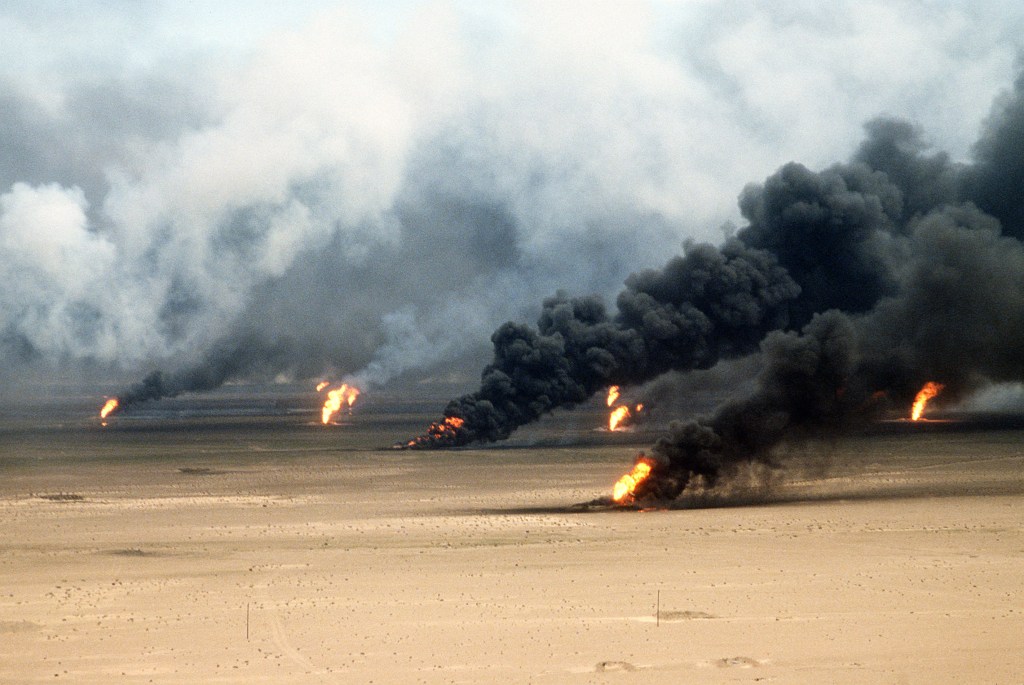
The environmental fallout will continue for years to come, with health impacts extending decades and even generations into the future. Particulate pollution, including neurotoxins and carcinogens, as well as potential endocrine-disrupting compounds, will travel with major wind currents across Asia, and may also reach across the Pacific.
All areas that experience fallout from this toxic cloud will experience harm to ecosystems, including contamination of agricultural lands, crops, and marine life harvested for human consumption. The food supply for hundreds of millions of people will likely be directly contaminated in the weeks to come, and that contamination will result in generations of sensitive species carrying cellular defects. Humans may also pass such unseen injuries to their children.
Without an intentional effort at widespread remediation of land, air, and water, toxic compounds will remain in the environment, with some places seeing worsening accumulation over time. It is difficult to quantify the direct economic impact of long-term health effects, but if hundreds of millions of people are exposed to dangerous toxins for several decades, it is certain the economic harm will measure in the trillions of dollars.
This means a region with greater economic and political instability, greater indebtedness and income inequality, and severely reduced trust in national and international leaders and institutions. The interconnected nature of the global economy and of key industries—such as food, textiles, information technology, and manufacturing—means this destabilization will not be limited to the immediately affected region.
The Geneva Conventions are binding constitutional law, under Article VI of the Constitution of the United States. They prohibit targeting of civilians or civilian infrastructure and require all available options be exercised to avoid direct or indirect harm to civilian populations. However tempting it may be to target fuel depots or economic infrastructure, it is a war crime to destroy civilian infrastructure or to create harm to civilians.
Some observe that the vulnerability and immensely destructive environmental impact of combustible fuels means the Iran war might have the unintented consequence of speeding a global transition to clean energy. While there may be some truth in this, it is also true that price shocks tend to drive consolidation, so that remaining fossil fuel purveyors will be more expansive, wealthier, and more influential.
Energy policy cannot be shaped intelligently, or sustainably, or in a way that benefits any nation’s long-term interests, through bombardment. Investors and agencies tasked with serving the public will have to accelerate development of non-polluting decentralized energy systems, which would be far less vulnerable to this type of physical and logistical disruption. But that is a separate question from that of legitimate governments honoring the univeral commitment not to target civilians or civilian infrastructure.
The people of the United States have an irreducible, unalienable human right to be served by a government that does not commit or tolerate such atrocities. The Congress and the Courts must act to stop any further military action that harms civilians, including the destruction of facilities containing polluting fuels.
 Rescue Rights & Freedoms