
The United States was founded on the simple moral insight that all human beings have unalienable human rights, including the right to life, which also means the right to remain free from arbitrary violence from anyone. Unalienable means that right can never be separated from the person—not any person, anwyhere, for any reason.
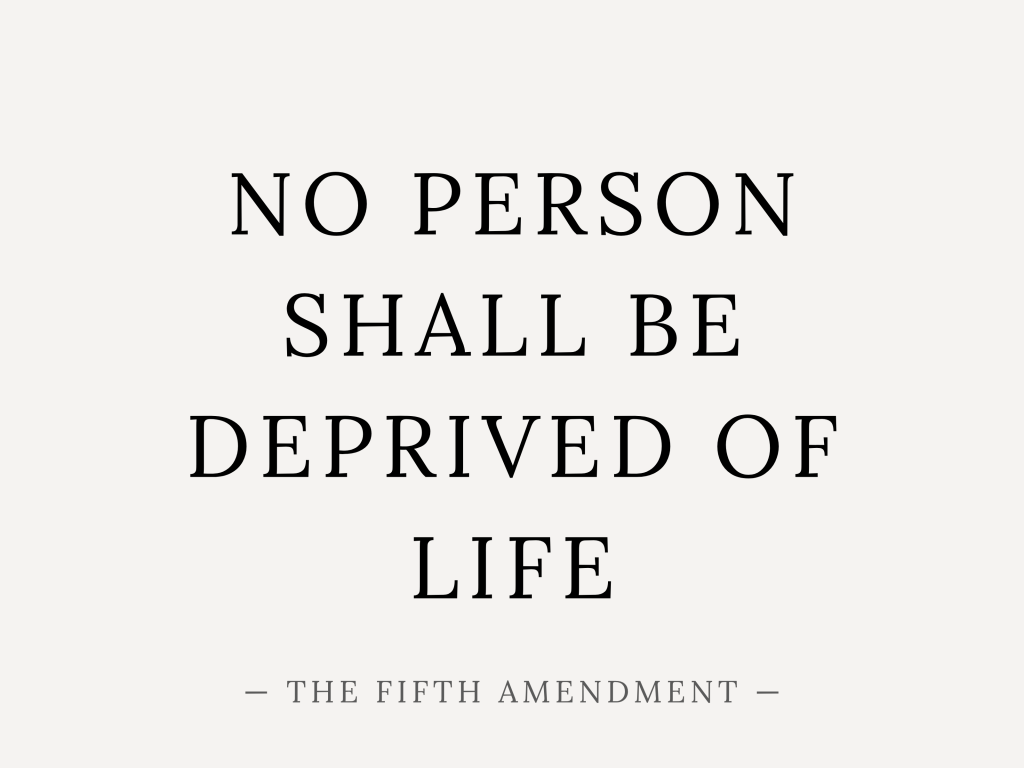
Long before the Geneva Conventions formally made it a war crime to murder civilians during active wars, the 5th Amendment to the Constitution of the United States clearly prohibited any form of official violence against civilians, or civilian infrastructure, by stating plainly:
“No person shall be… deprived of life, liberty, or property, without due process of law…”
The Bill of Rights does not limit this prohibition to the government’s actions against U.S. citizens, or people on U.S. soil. It prohibits the government from taking the life of any person without a criminal conviction, through an impartial court proceeding, resulting in a lawful sentence that would warrant such a punishment.
No part of the Constitution contemplates or envisions any authority for any person, including the President, to summarily end anyone’s life, anywhere, for any reason. This is intentional, and it is reflected and reinforced by the 5th Amendment and the Declaration of Independence.
Like the Magna Carta, the founding laws of the United States aimed to prevent an abusive leader from violating universal rights, even if the excuse were that armed conflict made such violations necessary or convenient. The framers of the Constitution understood that if a government can take life with impunity, then no right or freedom is safe.
The Geneva Conventions and the Universal Declaration of Human Rights were, in a sense, envisioned at the founding.
- First, the prohibition on arbitrary killing was made absolute, and no power was granted that could override that prohibition.
- Second, the entire cause of independence was formulated as standing on this bedrock.
- Third, Article VI of the Constitution makes ratified treaties “the supreme Law of the Land”—in other words: part of the body of Constitutional law.
- Fourth, the Universal Declaration of Human Rights is in many ways modeled on the Bill of Rights, and was similarly added to the U.N. Charter, which itself opens with the words ‘We the Peoples…’
These ratified treaties prohibit cruelty and arbitrary killing. They place strict constraints on the use of executive power in times of war, even when the war is truly just and defensive. They do this, because it was necessary, after two global wars resulted in more than 100 million deaths—the vast majority of them civilians—in three decades.
Again, a close reading of the Bill of Rights is helpful, to understand that the framers of the Constitution wanted these strict constraints on the use of public authority.
- The First Amendment ensures all of civil society is able to serve as a check on unaccountable power.
- The 3rd and 4th clarify that there is a zone of privacy around every human being.
- The entire Bill of Rights proactively protects the right to bear witness, and to have witnesses speak on one’s behalf, even if their testimony is inconvenient for those who hold power.
- The 8th explictly prohibits cruelty, and the 9th explicitly states that all rights are protected, even if they are not written into law.
- The 10th Amendment concludes with the recognition that power ultimately resides in the people.
On Tuesday, April 7, the world woke up to the shocking news that the President of the United States had made the incomprehensibly violent threat that “A whole civilization will die tonight…” His words suggested a plan was in motion to exterminate 90 million people and destroy all of their cultural heritage and all of the structures they had built, over thousands of years.
“No person shall be… deprived of life, liberty, or property, without due process of law…” says the 5th Amendment. Arbitrary killing and the destruction of civilian infrastructure, even in the midst of war, are absolutely prohibited by the Constitution. The Geneva Conventions make such atrocities war crimes and crimes against humanity.
The international laws that prohibit killing of civilians are a great achievement of the American democratic republic. It was the United States that led the creation of a post-World War II international system built on upholding human rights and outlawing authoritarian and genocidal violence. The prohibition of crimes against humanity is an extension of the Bill of Rights—both of its core logic and of its specific constraints on the use of power.
The President of the United States has no right and no legal authority to threaten genocide. He has no legal authority to order an offensive nuclear strike, or to destroy civilian infrastructure that could lead to widespread human suffering and mass death and destabilization. He has no legal authority to engage in collective punishment.
These prohibitions are absolute. The rights they protect are universal and unalienable. That is the founding purpose of the United States of America. The desire to do such evil to so many people is itself, even before the threat is made, a betrayal of the entire purpose of the United States. The threat is an abdication of the oath of office.
The American people do not want and will never tolerate genocide being committed in their name. No American leader who would contemplate such a thing can ever have legitimacy.
We are all fortunate that a temporary ceasefire was agreed by the end of the day, so that further escalation and actions that might trigger apocalyptic behavior were avoided, for now. The American people need our system of laws to work, to be well stewarded and applied, so we can know with certainty that no one in government will allow any genocidal actions or any kind of arbitrary killing or cruelty.
 Rescue Rights & Freedoms